Vamos a la Playa (Season 2)
The fifth issue of Sirena’s Whisper covered an exhibition in Paris and toured La Mode en Movement at the Palais Galliera, a museum of fashion and costume history. As the evolution of the swimsuit, an inseparable element in the relationship between humans and the sea, became the subject of the follow-up exhibition held at the same place with the same name, we continued to follow the traces of the history of sea pleasure.
Doesn’t even just the sentence in the title have a positive connotation to a person? It means “Let’s go to the beach.” It has always been difficult to say “No” to this proposal. Neither the Eiffel Tower, nor the Temple of Angkor, nor the ruins of Ephesus have caused such mass mobilization. Summer means beach for many. Sand sticking to the feet, sun loungers where you can never find the ideal comfort, the sun becoming increasingly dangerous due to the ozone effect and a lot of naked people we don’t know. No one cares about these things. We’d better go to the beach anyway, the beach of a hundred years ago.
La Mode en Movement, which traces the development of physical activity and the birth of modern sports to aristocrats who enjoyed outdoor recreational activities in England in the 18th century, explains that French society, which remained under the shadow of British influence, followed the same path, first with the elite and then with other classes. Hygiene theories, which formed the basis of French social policy in the 19th century, encouraged the public to engage in sports for health purposes. Thus, both men and women’s relationship with their bodies began to change. The concept of movement, inherent in any sporting practice, has caused the necessary evolution and adaptation of clothing and accessories, which has never stopped since then.
The second edition of La Mode en Movement exhibition continues its journey into the depths of history
The US’s nuclear bomb tests in the Marshall Islands in the Pacific Ocean in 1946 brought the name of the Bikini Atoll among those islands to the fore, and a few days later, Louis Réard, who introduced his new product in Paris, chose this name for his two-piece swimsuit design. The fashion world was introduced to this word when his bikini test attracted more attention than the bomb and was condemned more than the nuclear test.
However, there was a precedent for the work and the second version of the La Mode en Movement exhibition continued to travel in the depths of history. The exhibition overall reflected the same theme with different products and, in a way, emphasized the richness of the Palais Galliera’s collection.
Turover’s 1939 product catalogue includes Bouet-Willaumez’s drawings, which were also used in the May 1940 American edition of Vogue, and lists the items one should have when going to the beach as swimming caps, sandals, belts, headphones and plastic toys. Bouet-Willaumez is a drawer who worked for Vogue in the post-war period and became one of the style creators of Hollywood.
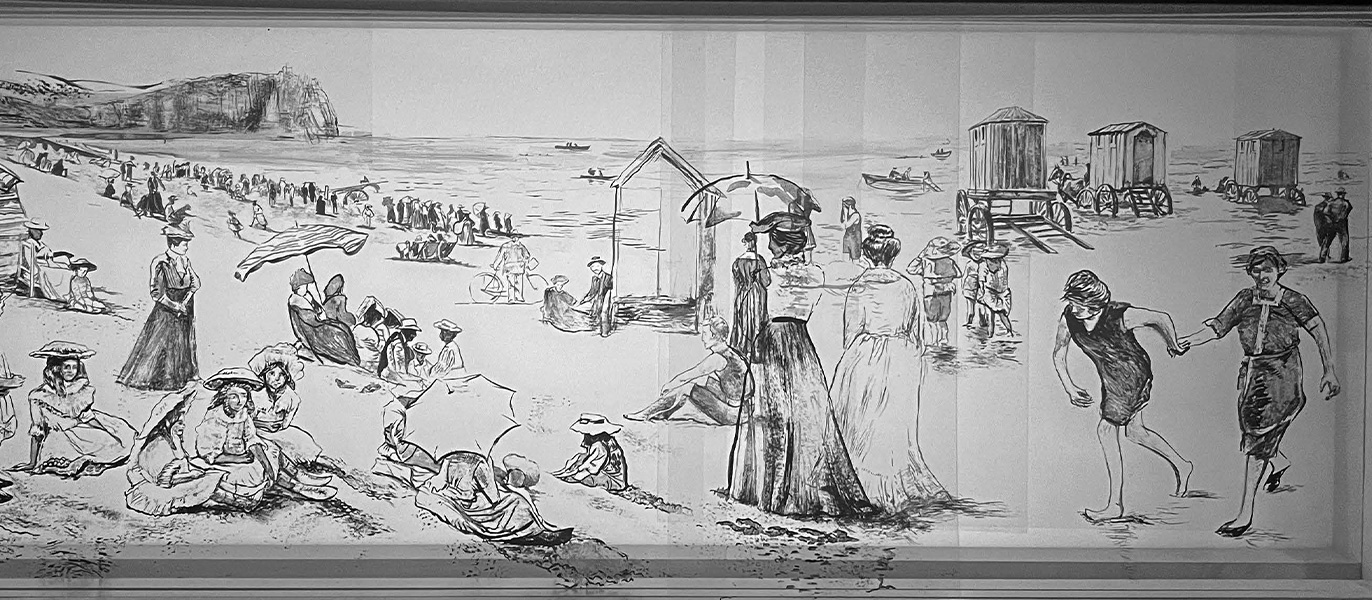
When we go back even further, we see that in the 1890s, swimsuits were not worn when going to the beach, but a style of clothing specific to this activity had developed. Drawings and examples of clothing from the period show that the use of hats, umbrellas and fans was almost mandatory. A railway poster about this period, when the concept of summer vacation was just starting to spread, includes the information that two hundred thousand people have been introduced to the joy of swimming in the sea in the last two years. This development was seen as a commercial opportunity for France’s railway company, and it was announced that beaches, among many other activities, were waiting for those who bought tickets to go to Foncillon or Pontaillac. However, in the 1830s, beaches were places associated with prohibitions rather than encouragement. A poster from 1837 warns the public that the rules to be followed on Granville beaches were carefully monitored by a special beach police. If you had gone to the beach in those years, you would have encountered the following prohibitions: The beaches were divided into three. Women and men could only swim in areas designated by the police, and a separate area was assigned to naked men. Men’s beachwear was subject to the rule and had to be two pieces. They could only undress in the cabin. It was strictly forbidden for men to approach the area reserved for women. It was mandatory to be under the super-vision of a doctor appointed by the governor’s office. It was forbidden to enter closed areas on the beach without obtaining a permit from the authorities. It was not possible to wash animals or cars in the beach area, nor could any belongings be left. It was only possible to enter the sea from the specified shores. Use of cabins and benches was subject to a fee. There could be no appeal against the punishment that the police deemed appropriate, and the parents would be responsible for any mischief their children might do.
In other words, the state, which told the public in the 1830s, “Think twice before going to the sea,” seemed to be saying, “Let’s go to the sea,” towards the end of the same century.