The Language of Seafaring
When the interaction of maritime terms between languages, etymological research, and dictionaries published in different periods are examined, it becomes clear that humanity felt the need to develop a separate language for life at sea. Although this language is an important element of global culture, it only concerns sailors.
The traditional language of seafaring has created a discourse that echoes the experience of sailing in almost every period. Since it includes the characteristics of land, wind, currents and the sky, it has to establish relations with different branches of science in many subjects, especially location determination. That’s why maritime dictionaries don’t just contain definitions of meaning in different languages. Each term can be a word that someone else needs and has no equivalent in their own language. It can be seen as an area of wisdom, containing endless details from the hull to the lantern light, from navigation to the crew. How the maritime language was formed, the etymological roots of the terms, the similarities in different languages, and the ties with ancient cultures create a separate world of meaning.
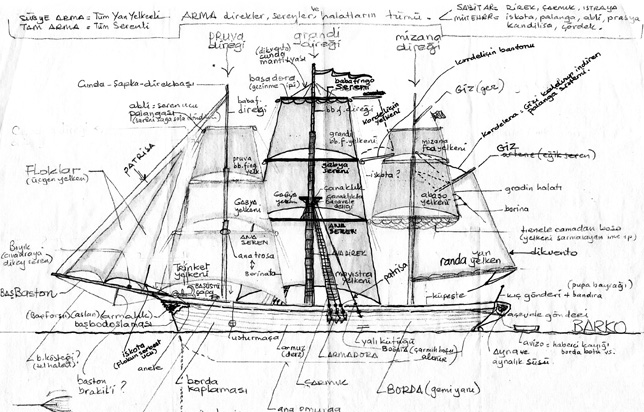
Maritime language is mostly shaped around three basic factors. Practical needs (navigation, manoeuvring, loading), cultural habits (vocabulary of coastal societies) and historical contacts (terms from other languages). A common terminology was developed, particularly for long sea voyages, and a clear description of the roles and actions on board was provided. In this regard, looking at etymology shows not only what terms mean, but also what contacts and inteactions led to the adoption of the language.
For example, in the maritime world, the word captain refers to the most fundamental rank. It comes from the Latin or Greek word “capitānus” and symbolizes direct authority. It did not enter Ottoman Turkish like the French capitaine or Italian capitano, but was settled as “Kaptanıderya”, giving it the meaning “sea-related”. In the example of “yelken” (sail) it is seen that the Turks preferred a unique term; however, almost all of the words related to sail types and their use were taken from other Mediterranean cultures. There are similarities between the sailing terms in ancient languages in all languages. It can be said that these similarities reflect the universal aspect of seafaring. Warning, command and signal words frequently used in seafaring are short, clear and understandable expressions shaped by practical needs. Such terms have ensured the continuity of this language and its survival from generation to generation until today.
When it comes to seafaring affairs, the cross-influence of languages is inevitable. Maritime terms in human history, filled with trade, war and exploration, create a common international maritime vocabulary due to the cross-lingual transmission. When looking at the Anglo-Norman influence, we see an intense interaction between English and French from the Middle Ages onwards and in the early modern period. Concepts such as “port” and “dock”, along with the use of basic directional markers such as “bow” or “stern”, evolved as a result of communication between these languages and have largely
come into common use.
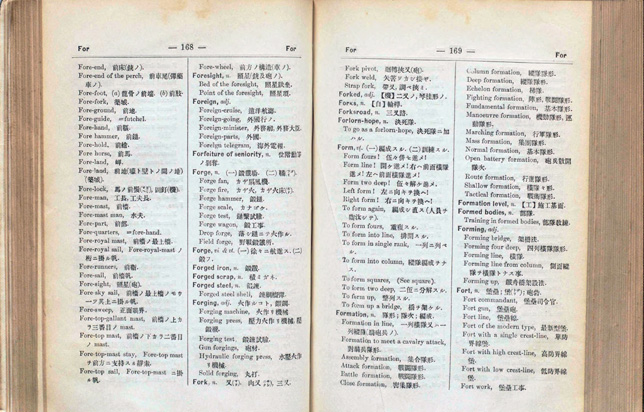
Italian and Spanish have also been influential in the spread of various technical terms in maritime language. Especially wind directions, maneuver names and loading steps have spread from these languages. Contacts between Indo-European languages are also reflected in maritime terms through trade routes across the Mediterranean. This interaction paved the way for maritime dictionaries to form in a multilingual and multi-layered structure.
The language of maritime is not just a technical communication tool. It would be more accurate to say that it is a cultural accumulation enriched by sea mythologies, trade and astronomical observations. Greek, Roman, Phoenician, Egyptian and Viking seafaring shaped the development of navigation, creating terms and concepts related to the position of the sun, the stars and wind directions that are still part of modern languages. Therefore, the names of ancient port cities have left indirect traces in the origins of some terms used today, such as “pharos”, “harbor” and “polis”. Therefore, maritime dictionaries are common sharing areas of collective memory and experience.
Knowing what a term means can be vital for safety and effective maneuvering. Quick and clear definitions also prevent misunderstandings within the team. Terms used today preserve maritime heritage by connecting to similar expressions used in the past. Modern seafaring is still an area of international cooperation. This language facilitates communication between international teams and increases operational safety. Even in today’s era of modern navigation devices and digital communication, the need for clear and concise conversations in the bridge remains the same.
Language is not only a way for seafarers to connect with their identity and past, but also a source of inspiration for literature and art. Poems, novels and films keep this language alive and pass it on to new generations. As we delve into the origins of the terms, examine the interactions between different languages and the ties established with ancient cultures, we see that this language becomes richer and deeper. Dictionaries, however, continue to exist as meaningful guides.