Peshtemal from hammams to yachts
A woven fabric that was used only in traditional Turkish baths until the present century has now become an indispensable accessory of the most prestigious yachts. Exclusive brands are incorporating it into their collections, it is spreading to the beaches of the world and ending the widespread and deep-rooted power of the towel. Its name is peshtemal.
The oldest known source about t is Filippo Argenti’s 1533 grammar book Regola del Parlare Turco (Rules of Turkish Speaking). It originated from a Persian word. When it is hand-woven by experienced craftsmen, it gains a unique touch and reveals its creator as if it carries the weaver’s signature. Since it is woven on a “primitive hand loom (karatezgah)” each piece is different from each other and, just like a carpet, carries its own unique features. This is what makes hand-woven peshtemal valuable. Although it is marketed today with phrases like “Combining comfort and functionality with the 2025 summer collection” or “Offering peaceful tones with different color options”, the revival of this piece of cloth is a new development. Until recently, it was not found outside the traditional baths, which are still working, and even its name almost faded into oblivion. The most general definition is a “bath towel woven from a cotton yarn.” But the fact that it has a history of about 600 years puts it in the position of being a cultural object. In other words, the peshtemal, that is used today on the beaches, by the pools, in the gyms, yoga classes and yachts in the USA, Australia, England and Europe, is the subject of a long story starting from Anatolia.
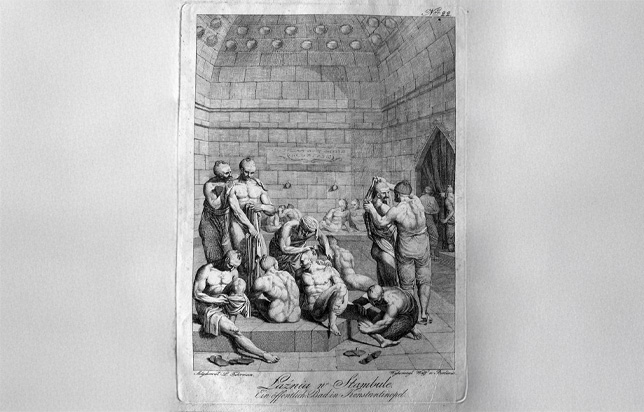
One of the reasons why it is being reused today is that it is lighter than normal towels, dries faster and is more stylish. The peshtemal, which takes on a color and shape according to the climate of the region in which it is traditionally used and is woven in a thickness compatible with the weather conditions, was also used for other purposes, especially on the Black Sea coast. Its functions such as preventing daily clothes from getting dirty, hiding pregnancy, and carrying picked fruits and vegetables on the lap made the peshtemal an fundamental item, and it was called “dolaylık” when tied around the waist and “keşan” when tied around the head.
The classic peshtemal was usually produced in rectangular shape, fine woven structure and fringed edges. It gets softer as it is used and its absorbency would increase. It was fundamental that it was one hundred percent cotton. Cotton types such as high quality Turkish cotton, Aegean cotton or sea island Egyptian cottons were preferred because they gave more durable and soft results. Today, all types of yarn are used in the textile industry and it is not expected to have these characteristics to call a cloth a peshtemal.
When choosing a peshtemal, the purpose of use should be determined first. Different types with different features can be preferred for use in bathhouses, boats, or purely for decorative purposes. As with any garment, fabric quality is again the most important factor. Peshtemal made of high quality cotton or natural fibers are more durable and comfortable. The density of the weave directly affects its durability and absorbency. Since the grammage value indicates the thickness and weight, medium weights between 150-200 g/m2 are ideal for use on yachts. An important point is the quality of the fringe. Since the fringes complete the aesthetic look, they must be tied securely. Considering the place of production and ethical production conditions, those produced in licensed traditional weaving centers should be preferred due to their authenticity and quality.
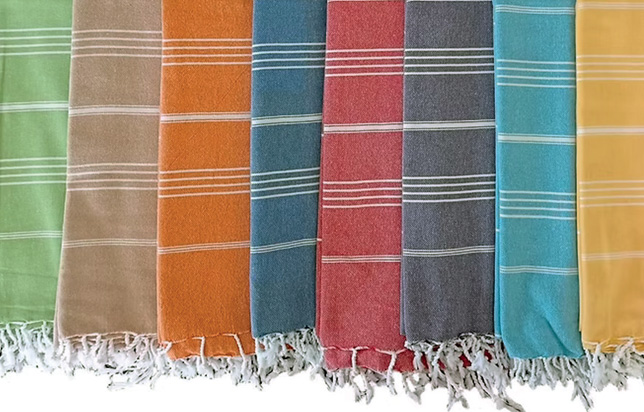
Peshtemal, which is used as a body cover in Turkish baths, is still an fundamental part of this culture. The reason why its standard dimensions are 90-100 x 170-180 cm is that it fully covers an adult’s body and provides enough space to lie on it. The traditional Turkish peshtemal is usually woven with striped patterns and decorated with blue, red, green or black stripes on natural cotton. These classic patterns have survived unchanged for centuries and offer an authentic look. In modern designs, there is a wider range of colors and patterns. Since it is produced using a flat weaving technique, the presence of fluff on its surface makes it thin, compact when folded, and lightweight, which explains why it is so popular on yachts. An average beach towel weighs around 500-700 grams, while a peshtemal weighs 150-300 grams. Peshtemal usually gains absorbency after a few washes and performs better over time. It is also durable. Nevertheless, the correct cleaning and maintenance methods should be applied to extend its usage and maintain its performance. It is recommended to wash it before the first use. This process removes chemicals that remain on the fabric during production and allows the fibers to open. It is important to shake off the towel to remove salt water and sand and, if possible, rinse with fresh water, after each use. The salt crystals can damage the fabric fibers and cause hardening over time. You should check for stains before washing and pretreatment should be applied if necessary. Sunscreen, oil, or fruit stains can be treated by applying mild soapy water to the stained area. For machine washing, a gentle or medium wash program should be preferred with similar colored items. The temperature should usually be between 30-40°C. High temperatures can cause discoloration and damage to the fabric. When choosing detergents, natural and sensitive products that do not contain softeners should be preferred. Softeners reduce the absorbency characteristic by coating the fabric fibers. The drying process should preferably be carried out in the open air and at a flat space. It is more convenient to dry in the shade, as direct sunlight can cause colors to fade. If it is going to be dried in a dryer, a low temperature setting should be selected. In addition, regularly combing and straightening the fringe prevents it from getting tangled and preserves its aesthetic appearance. It should also be stored in a clean, dry and airy environment when it is not used. Because moisture can cause mold to form.
Although hand-woven peshtemal craftsmen continue to produce today, their number has decreased significantly compared to before. As in every sector, it has fallen into oblivion as a victim of mass production and synthetic tissues. It is hoped that with renewed interest, the last craftsmen will train new apprentices.