A Yacht Scientist
A session at the 44th OMAE 2025 (International Conference on Ocean, Offshore & Arctic Engineering), held this year in Vancouver, was in honor of Prof. Dr. Sander Çalışal.
Born and raised in Anadoluhisar, one of istanbul’s Bosphorus districts, Sander Çalışal graduated from Galatasaray High School and Robert College’s Department of Mechanical Engineering. After specializing in ship engines and hydrodynamics, he became a world-renowned researcher and instructor. Çalışal, who lives in Canada and tests America’s Cup boats in the laboratory he founded at the University of British Columbia, where he is an Emeritus Professor, is among the scientists who shape the yacht industry, in addition to many academic publications.
Çalışal’s primary goal in boat design is to incorporate crew and passenger safety into the design cycle.
Çalışal is also testing the safety of other boats with a small group of researchers at UBC’s Naval Architecture Lab. His numerical and experimental studies on ferries, which play a vital role in connecting Vancouver Island to the mainland, provide a better understanding of water accumulation on the large decks of Ro-Ro vessels and enable them to be made safer.
Another project he has undertaken in collaboration with a local naval architecture design office is a plan to apply the non-linear thin hull code to standard ships. This work also includes the application of a thin body that creates a vortex. This procedure is expected to be more efficient than three-dimensional codes in time-domain computations. Sander Çalışal’s main goal in boat design is to include crew and passenger safety in the design cycle. The study primarily addresses fishing boat designs.
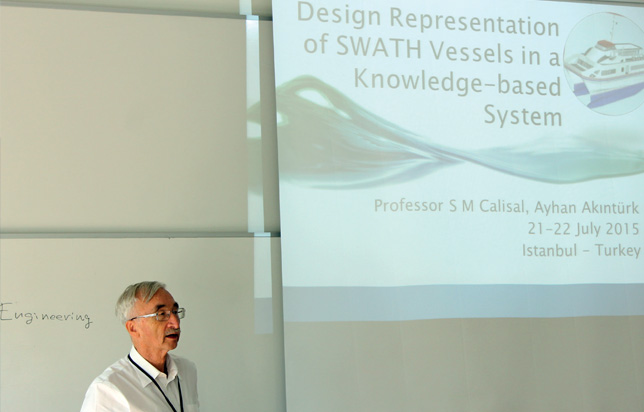
Çalışal’s experimental studies includes a new procedure called parabolization of waterlines to reduce the resistance created by ships as they move. He is developing an optical system to measure the six degrees of motion of a self-propelled ship model in its towing tank, aiming to simplify model preparation for large motion studies, including ship capsizing. There is no end to his projects. Adapting an UBC inlet to a human-powered submarine is one of them.